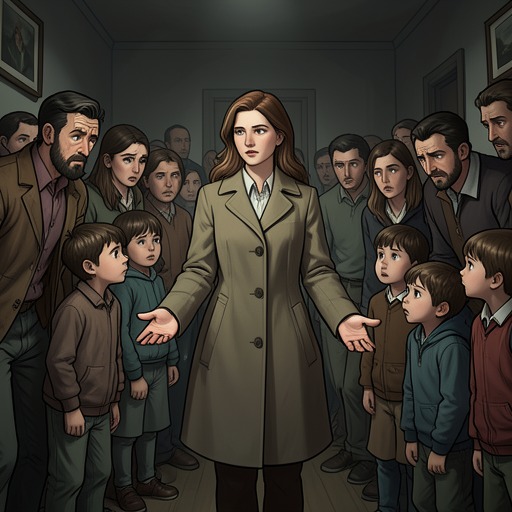
Orphanage Closure and Acquisition Crisis State
I’m Very Happy After Marrying the CEO Husband According to the AgreementThe Orphanage Closure and Acquisition Crisis State is the condition in which the small private orphanage faces both forced closure and an attempted purchase. Its decisive significance lies in the gap between the language of improved care and the reality of institutional control: officials present relocation as a practical solution for vulnerable children, while Dean Mum recognizes that acquisition would transfer ownership of the place that has sheltered them and preserved their history.
The Orphanage and Its Decline
The crisis becomes visible when Shen Tang arrives at the orphanage carrying a truck full of clothes, snacks, learning materials, toys, and other supplies. Instead of finding a quiet homecoming, she encounters a crowd outside the gates and Dean Mum sitting on the floor, crying while holding a child. Dean Mum explains that she has been ordered to close the orphanage and fears that the children will be bullied elsewhere if the institution disappears.
The orphanage once held a stronger position. Decades earlier, it had been the only private orphanage in the area, and donations were more plentiful. Its decline began after a larger orphanage opened nearby about ten years earlier, offering better facilities and an environment that attracted more attention. The older institution was left with children who were harder to place: most of the remaining residents had disabled bodies, and more than a dozen children were still living there without able bodies.
The narrative does not treat disability merely as a sentimental emblem. It connects the children’s vulnerability to concrete institutional conditions. Children with disabilities were more likely to be abandoned, and the psychological consequences of abandonment could produce difficult behavior, including bad tempers and hitting. Dean Mum nevertheless refused to discriminate against them, patiently soothing them until they gradually adjusted. The orphanage’s value therefore rests not only in its building or resources but in the continuity of care that Dean Mum has built through repeated, personal labor.
The Merger Proposal and Its Hidden Stakes
The person-in-charge who confronts Dean Mum wears an immaculate suit and presents himself as an intermediary acting on instructions from above. He argues that the orphanage is too small and that merging it with the larger neighboring institution would give the children better care. He cites superior surroundings, medical resources, and facilities, emphasizing that the children’s disabilities make access to treatment especially important. Some bystanders accept this reasoning, pointing to the old building and the lack of helpers as proof that merger is sensible.
Shen Tang refuses to accept the promise without verification. She asks which authorities issued the order, whether there is a written notice, and how anyone can guarantee that the children will actually receive better treatment rather than be bullied in the new institution. Her questions identify the central uncertainty in the proposal: a verbal assurance from an official-looking representative cannot protect children within an institution where resources may be unevenly distributed and relationships are not necessarily harmonious.
Dean Mum is briefly shaken because the offer appeals to the children’s real medical needs. She eventually says that she would be willing to close the orphanage if better treatment could be guaranteed. The apparent concession, however, is based on the assumption of closure and improved care, not on surrendering the property to a private buyer.
The Acquisition Confrontation
The representative then produces a purchasing contract and claims that signing it will ensure that the children are properly cared for. When Dean Mum skims the document, she realizes that the proposal is not simply to close the orphanage or merge its residents. The other party intends to buy the place itself. Closure and acquisition are therefore revealed as fundamentally different outcomes: closure would leave the institution’s identity and decisions in the hands of its own guardians, whereas acquisition would make the orphanage someone else’s property.
The discovery is especially painful because the orphanage contains Dean Mum’s fondest memories. The building is not an interchangeable shelter in her eyes; it is the accumulated setting of her life with the children. Her response is immediate and unequivocal: she does not agree. Shen Tang takes the contract and tries to photograph it so that contract professionals can examine its terms, but the representative stops her and says that the document cannot be leaked. The refusal to permit outside scrutiny deepens the suspicion that the reassuring language about care conceals interests beyond the children’s welfare.
Shen Tang’s Position and the Crisis’s Meaning
Shen Tang’s arrival with material supplies initially presents her as a benefactor returning to support a familiar community. The confrontation turns that gesture into a test of responsibility. She does not merely comfort the children or accept the official account; she asks for documentary authority, enforceable guarantees, and the right to have the contract reviewed. Her intervention gives the orphanage a defender capable of translating private affection into public challenge.
The crisis also contrasts two kinds of value. The larger orphanage possesses visible advantages—better facilities, medical resources, and a more attractive environment—while the smaller orphanage possesses relational knowledge, patience, and a history of protecting children whom other institutions may find difficult. The proposal treats care as something measurable through buildings and equipment, but the orphanage’s residents reveal that care also depends on whether adults remain committed when children are disabled, emotionally distressed, or unlikely to attract donations.
At the same time, the unresolved contract leaves the immediate outcome open. Dean Mum has rejected the purchase, Shen Tang has questioned the representative’s authority, and the document has not yet been independently reviewed. The state therefore ends not with a completed transfer but with the hidden structure of the threat exposed: a promise of better treatment is being used to make an acquisition appear morally necessary, while the children and the people who care for them risk losing control over their home.